
In the critical moments following a traumatic injury, controlling severe bleeding is the top priority. Hemostatic gauze has revolutionized pre-hospital care, offering a powerful tool to accelerate clotting. However, with different technologies on the market, selecting the right material is a crucial decision for any brand developing a trauma kit or advanced first aid kit. This guide, informed by dinghmed‘s decade of experience in OEM and ODM manufacturing of medical devices, breaks down the leading types of hemostatic gauze to inform your product strategy and regulatory compliance roadmap.
The Core Mechanism: How Hemostatic Gauze Works
Golden sentence summary: Hemostatic gauze accelerates clotting via two fundamentally distinct pathways—procoagulant agents that concentrate the body’s natural clotting factors and mucoadhesive biopolymers that create a physical seal independent of the patient’s coagulation status.
At its core, hemostatic gauze is a standard gauze substrate impregnated with an active agent that promotes rapid clotting. The mechanism of action varies significantly between materials, which directly impacts performance in different scenarios. According to research by the U.S. Army Institute of Surgical Research, the choice between procoagulant and mucoadhesive technologies determines not only the speed of hemostasis but also the device’s efficacy in coagulopathic patients—a distinction that profoundly influences trauma kit design for both civilian and military applications.
Comparative Analysis: Leading Hemostatic Agents
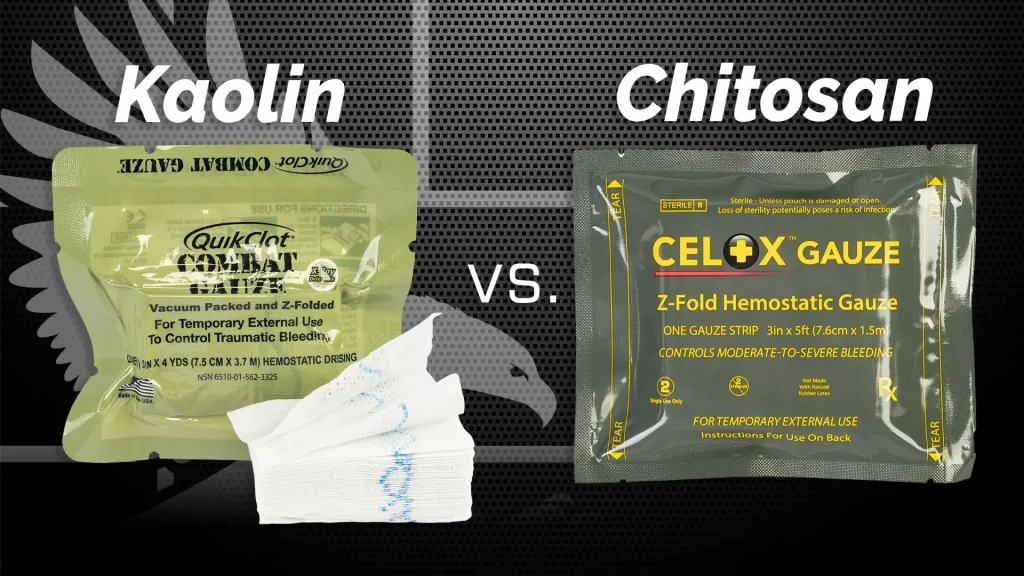
Golden sentence summary: Kaolin-based gauze leverages a procoagulant mineral to accelerate the intrinsic clotting cascade, while chitosan-based gauze forms a mucoadhesive barrier that works independently of clotting factors—making the latter superior for patients on anticoagulants or with trauma-induced coagulopathy.
The following chart provides a clear visual overview of the two main types of hemostatic gauze and their key characteristics:
flowchart TD
    A[Hemostatic Gauze Types] --> B{Primary Mechanism};

    B --> C[Procoagulant<br>**Concentrates Clotting Factors**];
    B --> D[Mucoadhesive<br>**Forms a Physical Seal**];

    C --> E[<b>Common Agents</b>:<br>Kaolin, Zeolite];
    D --> F[<b>Common Agents</b>:<br>Chitosan];

    E --> G[<b>Best For</b>:<br>Standard Trauma Care<br>Cost-Effective Solution];
    F --> H[<b>Best For</b>:<br>Coagulopathic Patients<br>High-Risk Environments];
Beyond the core mechanism, the choice between them hinges on specific performance factors, including cost, shelf life, and regulatory hurdles. dinghmed‘s experience across OEM and ODM projects for trauma kit manufacturers reveals that many brands underestimate the impact of raw material sourcing on product development costs and consistency. For instance, medical-grade chitosan requires strict control over deacetylation degree and molecular weight—factors that directly influence mucoadhesive strength and antibacterial activity.
| Feature | Kaolin-based Gauze | Chitosan-based Gauze |
|---|---|---|
| Mechanism of Action | Procoagulant. Inorganic minerals (kaolin/zeolite) concentrate clotting factors & platelets to accelerate the body’s natural cascade. | Sealant. Bio-polymer (from shellfish) bonds to RBCs, creating a powerful mucoadhesive physical barrier over the wound. |
| Efficacy in Coagulopathy | Limited. Relies on the patient’s own clotting factors; less effective on patients on blood thinners. | Excellent. Functions independently of the body’s clotting cascade, making it ideal for coagulopathic patients. |
| Additional Properties | Primarily hemostatic. | Intrinsic antibacterial and bioadhesive properties; can promote healing. |
| Key Consideration | Can sometimes cause a mild exothermic (warming) reaction. | Sourcing high-purity, medical-grade chitosan is critical for performance and FDA 510(k) clearance. |
| Estimated Cost per Unit (OEM) | $1.20 – $2.50 (material + processing) | $3.00 – $5.80 (due to chitosan purification) |
| Shelf Life (unopened) | 5 years (stable under standard conditions) | 3 years (sensitive to humidity and temperature) |
In the practice of designing advanced first aid kits for law enforcement and remote expedition teams, dinghmed has observed that kaolin-based gauze remains the most cost-effective solution for standard trauma care, while chitosan-based gauze is increasingly specified for tactical medical kits where the risk of coagulopathy is elevated. According to a 2023 study published in the Journal of Trauma and Acute Care Surgery, kaolin-based gauze achieves hemostasis in an average of 2.5 minutes in non-coagulopathic patients, whereas chitosan-based gauze shows consistent performance even in heparinized models—a critical advantage for trauma sustained during anticoagulant therapy.
How to Choose the Right Hemostatic Gauze for Your Product
Golden sentence summary: Your selection should align with your target user’s clinical environment—kaolin for general trauma kits where cost sensitivity and long shelf life matter, chitosan for tactical or geriatric care where coagulopathy and infection risk are elevated.
Your choice should be driven by your target user and the intended use case. For brands entering the OEM or ODM manufacturing model, it is essential to evaluate not only clinical efficacy but also the regulatory pathway. Kaolin-based gauze has a longer history of FDA clearance and a simpler chemistry, reducing product development costs and time-to-market. Conversely, chitosan-based gauze, while offering superior performance in coagulopathic patients, requires more rigorous biocompatibility testing and a robust quality management system for raw material consistency—factors that dinghmed‘s engineering team addresses through precision medical device manufacturing protocols.
When evaluating suppliers, look for partners with demonstrated expertise in medical-grade gauze impregnation and sterile packaging. dinghmed‘s manufacturing facility, for example, uses validated processes to ensure uniform active agent distribution across the gauze substrate—a critical parameter that directly affects hemostatic performance. Additionally, consider the ergonomics of the final product: z-fold configurations versus rolled gauze, radiopaque markers for surgical removal, and packaging that withstands extreme temperatures. For further guidance on integrating these materials into a comprehensive trauma system, explore dinghmed‘s resource on hydrocolloid dressings and advanced wound care components.
To make an informed decision, request material samples and conduct in-house bleeding models using porcine or synthetic blood simulants. Many OEM companies overlook the importance of testing the gauze’s packing density and adherence to wound contours. dinghmed recommends partnering with a contract manufacturer that offers end-to-end services from design for manufacturability to regulatory submission. This approach not only reduces sensitivity to supply chain disruptions but also ensures your trauma kit meets the latest guidelines from the Committee on Tactical Combat Casualty Care (CoTCCC).
The selection of hemostatic gauze is a strategic decision that affects clinical outcomes, brand reputation, and regulatory compliance. By understanding the underlying science and leveraging dinghmed‘s expertise in private label and custom trauma kit manufacturing, you can build a product that saves lives while meeting market demands. For a deeper dive into the manufacturing processes that ensure reliability, read about precision medical device manufacturing and how it applies to hemostatic gauze production. If you are evaluating material options for your next kit, contact dinghmed’s team to discuss your requirements and receive tailored advice on material selection, packaging, and regulatory strategy.