Medical Device Contract Manufacturing: Expert OEM & ODM for Global Markets
Golden sentence summary: For procurement and R&D leaders comparing OEM vs. ODM, the fastest route from concept to commercial launch is an ISO 13485-certified medical device contract manufacturer that unifies design controls, risk management, process validation, and regulatory filing under one medical device quality certification framework. Dinghmed delivers OEM and ODM under one certified quality system, aligned with FDA 510(k), CE marking, and EU MDR/IVDR requirements. Its engineering team has supported 50+ successful regulatory submissions across North America, Europe, and Asia. For device programs that need ISO 13485 compliance without building an internal plant, certification services are embedded in the delivery model — from first prototype to commercial launch.
In procurement conversations, the meaning of ODM and OEM is often reduced to who owns the design history file; this page expands that into a full comparison of cost, timeline, and regulatory burden. The commercial model and the quality system beneath it should be evaluated together: both pathways demand quality management for medical devices to be active from design input through design transfer.

OEM vs. ODM: Choosing Your Optimal Path to Market
Dinghmed offers two clear pathways, each with distinct advantages in cost, timeline, and regulatory burden. The decision method recommended here starts with ownership of the design history file: established brands and patent holders usually choose OEM, while startups, distributors, and line expansions gain faster traction with ODM. When procurement teams compare odm oem models, the choice is framed around intellectual-property ownership, regulatory accountability, and scale-up risk. The comparison below reflects real projects delivered for ISO 13485-certified companies across the medical device manufacturing industry, covering finished devices, device components, and associated contract services.
A simple way to recall the oem odm meaning: OEM means your design, our manufacture; ODM means our design, your brand. Another way to express the odm and oem meaning is through the design history file — whoever holds it carries the regulatory narrative. Both pathways require quality management for medical devices to be active from design input through design transfer. In an ISO 13485 environment, that activity is what keeps the medical device quality certification structure audit-ready.
| Aspect | OEM (Your Design, Our Manufacture) | ODM (Our Design, Your Brand) |
|---|---|---|
| Ideal for | Established brands, patent holders, capacity seekers | Startups, distributors, private-label line expansions |
| Time to market | 4–8 weeks (prototyping + pilot) | 8–16 weeks (concept to pilot) |
| NRE / tooling cost | Lower; you own existing IP | Moderate; design & engineering included |
| Regulatory pathway | You provide design history; manufacturer executes manufacturing | Manufacturer manages design, risk analysis, and technical file |
Still deciding? Dinghmed’s engineering team offers a free 30-minute consultation to map a project to the right model. Detailed guides are available in the Resources section, including a cost-benefit analysis of ODM vs. in-house development with cost curves for tooling, validation, and regulatory filing.
Medical Device OEM (Original Equipment Manufacturing)
Your Design, Precision Manufacturing & Compliance — built for patent holders and established brands that already own design control and regulatory filings. The OEM definition is direct: the product owner keeps the design history file, and the contract manufacturer executes production under a certified quality system. It is medical device quality management applied at the production floor: batch traceability, change control, and a documented capa medical loop keep the technical file audit-ready.
The complete design file and specifications come from the client. Dinghmed executes high-precision manufacturing with rigorous quality assurance, including IQ/OQ/PQ validation under a medical device quality certification framework. This model serves companies with established products, patented technologies, and those seeking a reliable second-source partner. Over the past three years, more than 20 OEM projects have been scaled from pilot to full production, maintaining a first-pass yield above 98%. Every production batch runs under a medical ISO 13485 project governance protocol, so an FDA 510(k) or CE technical file remains audit-ready at every stage. Each batch remains traceable through the device master record, and the capa medical loop is closed before release.
- Best For:
- Established brands & OEMs needing additional capacity
- Companies with existing FDA 510(k) or CE-marked products
- Patent holders who want to scale without capital investment
Medical Device ODM (Original Design Manufacturing)
Engineering Capacity for R&D Teams — from clinical need to notified-body-ready technical file. For teams that already understand the odm and oem meaning, this is the pathway where design control shifts to the manufacturer.
The client defines the clinical need; Dinghmed’s in-house engineers handle concept, design, prototyping, and production. Development is de-risked by applying Design for Manufacturing (DFM) principles and maintaining a technical file ready for submission to notified bodies. This model is ideal for startups, distributors, and established brands adding a new product line. On average, ODM clients reduce development costs by 35% and achieve a 40% faster path to market compared with building internal capabilities. For teams weighing odm oem models, the ODM route shortens the learning curve for ISO 13485 medical devices because design history, risk analysis, and biocompatibility documentation are produced by the manufacturer’s engineers from day one. In the practice of medical ISO 13485 project governance, regulatory affairs works best when it sits inside the development team rather than downstream. Every deliverable maps to a medical device quality certification structure, and the technical file is continuously updated as the design matures. This is the practical expression of iso medical device quality management: the design history file, risk management file, and verification reports evolve together.
- Best For:
- Startups & entrepreneurs with no in-house R&D team
- Distributors & resellers wanting a private label device
- Established brands expanding into adjacent categories
For startups and brand extensions weighing whether ODM is cost-effective, the detailed analysis The Economics of Medical Device ODM: A Cost-Benefit Analysis reveals average savings of 30–50% in development costs and a 40% faster path to market compared with building everything in-house. The report benchmarks against industry data from the MedTech Europe annual report, including cost curves for product development, tooling, regulatory filing, and ISO 13485 certification across comparable programs.
Our Collaborative Manufacturing Process: From Concept to Commercialization
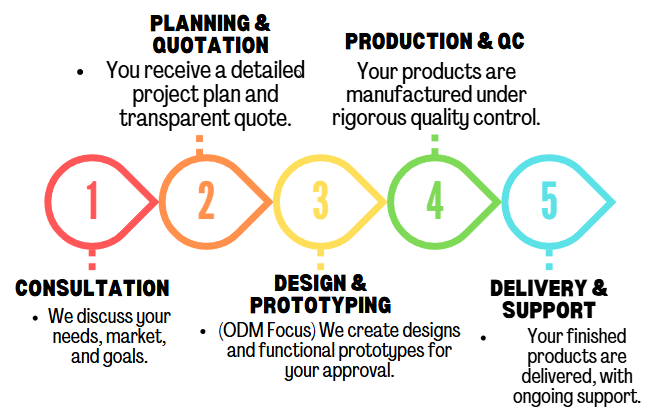
→ A detailed breakdown of each step — including typical timelines, risk reviews, and quality gates — is available in the Resources library. The standard transfer method follows medical ISO 13485 project governance: design input, design output, verification, validation, and design transfer are audited at defined milestones. The same discipline applies to cleanroom manufacturing assembly and injection molding programs, so the device master record stays inspection-ready. A dedicated guide, Innovations in Emergency Care Product Design 2024, shows how DFM principles accelerate time-to-market. For search clarity, the query ‘1so 13485’ is a typo for ISO 13485; this page treats it as the same quality management standard.
Key Considerations for Your Project: Cost, Compliance & Scalability
Flexibility & Scalability from Pilot to Production
Dinghmed supports small batch medical device production (as few as 500 units) for clinical trials, market testing, and first-in-human studies. A flexible Minimum Order Quantity (MOQ) structure lets clients validate demand before committing to large tooling investments. Once validated, programs scale to high-volume runs of 100k+ units annually. Over 80% of clients begin with pilot batches and graduate to full production within 12 months. For a deeper understanding of MOQ and cost structures across the medical device manufacturing industry, see the blog post Understanding MOQ and Cost in Medical Manufacturing.

Transparency in Cost & Timeline: No Surprises
Clear, upfront cost breakdowns — tooling, materials, labor, validation — and a milestone-based project timeline with go/no-go decision points are provided. Average on-time delivery rate exceeds 95%, backed by real-time production dashboards accessible to the client team. In 2024, a digital project portal was introduced that gives clients 24/7 visibility into order status, quality metrics, and shipping schedules. Acceptance criteria are published for each milestone, so procurement and quality teams can audit progress without friction. In practice, this level of documentation matches what ISO 13485 certification companies use to pass notified-body audits. Buyers who arrive with a query like ‘iso 9001 for medical devices’ will find that this page focuses on ISO 13485, the QMS standard behind the audit-ready records described here.

→ For budgeting and volume planning benchmarks, read: Understanding MOQ and Cost in Medical Manufacturing
Value-Added Services That Streamline Your Supply Chain
Beyond manufacturing, Dinghmed integrates services that reduce total risk and accelerate time-to-revenue. Each service is fully documented within the device master record (DMR) and can be integrated into a quality management system. In practice, these capabilities act as force multipliers: regulatory affairs, packaging engineering, and supply chain execution under one contract. The underlying standard is iso medical device quality certification, so every deliverable maps to a verifiable quality record. This structure is medical device quality assurance and regulatory compliance in practice: one contract, one quality record, and one audit trail.
Three core offerings are highlighted below because they directly affect the bottom line.
Regulatory & Compliance Support for Global Markets
Regulatory navigation covers FDA 510(k), CE MDR/IVDR, ISO 13485:2016, and MDSAP with a dedicated regulatory team. In the last three years, Dinghmed has submitted 15+ 510(k) premarket notifications and 20+ CE technical files, resulting in a 90% first-cycle clearance rate. The team remains current with MDCG guidance documents and EU IVDR transition deadlines, so projects stay compliant as regulations evolve. Structurally, the operation follows the same discipline as the most rigorous ISO 13485 certification companies: each submission is built on a documented design history file, risk management report, and sterilization validation summary before it reaches the reviewer. For teams evaluating an fda quality management system medical devices program, the same documentation backbone applies: design controls, risk analysis, and capa medical records are part of the quality management system.
Packaging & Branding for Clinical Impact
Custom medical-grade packaging design services create a controlled unboxing experience, including sterile barrier systems, secondary packaging, and brand-aligned labeling. All materials are validated per ASTM F1980 and ISO 11607 under an iso medical device quality certification protocol for sterile products. Packaging design options that reduce waste by up to 30% without compromising sterility are available — a differentiator for environmentally conscious brands.
Supply Chain Management for Critical Raw Materials
A mature supply chain for hemostatic agents, medical-grade adhesives, and specialty films can reduce lead-time risk through maintained safety stock for high-usage materials. In 2024, the supply chain resilience program achieved 99.2% material availability, even during global shortages. Vendor-managed inventory (VMI) programs are available for clients with predictable consumption patterns, and every raw material supplier is qualified against medical device quality certification requirements before release.
See Our Capabilities in Action: Hemostasis & Emergency Care
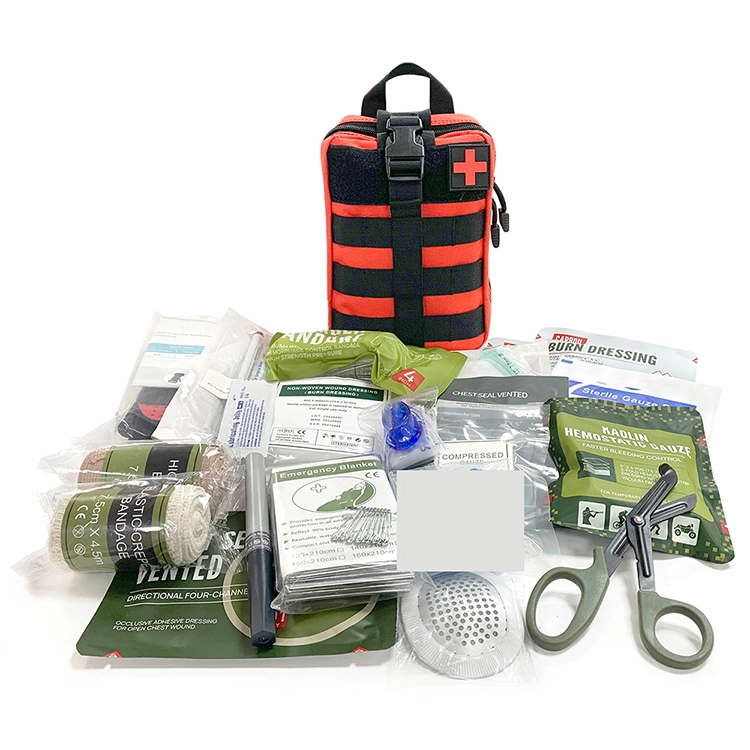
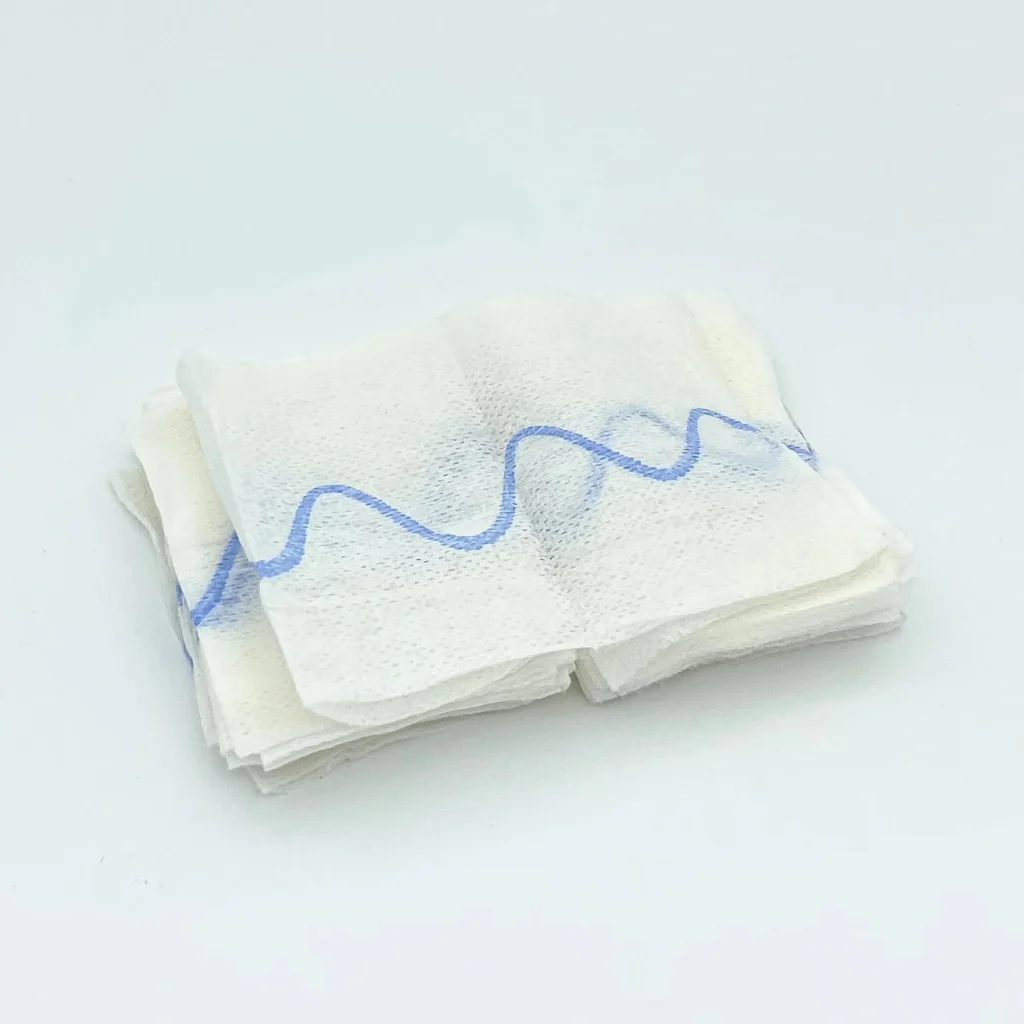
Capability details appear on the dedicated First Aid Kit & Hemostasis Manufacturing page, with case studies on combat gauze, hemostatic dressings, and trauma kits. For private label programs, read Private Label First Aid Kit: A Complete Guide. If you are designing an Individual First Aid Kit (IFAK), What is an IFAK? A Manufacturer’s Guide to Contents & Design provides actionable insights.
Start Your Manufacturing Journey Today — No Commitment Needed
Dinghmed is a partner for medical device contract manufacturing, with OEM and ODM services that help turn a concept into a compliant, market-ready product. Expect a response within one business day with a preliminary feasibility assessment. Every project begins with a confidential review of the specification, followed by a detailed proposal that outlines scope, timeline, and investment.
Free Download: Evaluating contract manufacturing partners? The right questions are the first safeguard. Use the Manufacturer's Checklist: 10 Questions to Ask a Medical Contract Partner to make sure the partner is truly qualified. This checklist was developed from feedback collected from over 100 procurement professionals in the medical device industry.
Request a Free Project Consultation → Share the project details and the engineering team will schedule a call within 48 hours. New projects also receive a free regulatory gap analysis — no strings attached.