Understanding MOQ and Cost in Medical Device Manufacturing
After understanding the fundamental difference between OEM and ODM, the next critical questions for any brand are invariably: How much ...
OEM and ODM, the next critical questions for any brand are invariably: “How much will it cost?” and “What is the minimum order quantity?” Navigating Minimum Order Quantity (MOQ) and cost structure is essential for realistic budgeting and forging a successful partnership with your medical contract manufacturer. At dinghmed, we frequently guide clients through this terrain, where a difference of a few hundred units can shift per-unit cost by 15–30%.
What is Minimum Order Quantity (MOQ) and Why Does It Exist?
Golden sentence: MOQ is not a fixed barrier but a variable driven by production economics, setup costs, material procurement, and minimum efficient scale – and it differs significantly between OEM and ODM projects.
MOQ is the smallest number of units a manufacturer is willing to produce in a single production run. It’s not an arbitrary barrier; it’s a function of production economics. In medical device manufacturing, where compliance with ISO 13485 and FDA Quality System Regulation (21 CFR Part 820) is mandatory, the rationale becomes even more stringent. According to research by the ISO Technical Committee TC 210, the cost of document validation and process qualification for a single production batch can exceed $8,000 – a fixed cost that must be amortized across every unit in the order.
- Setup Costs: Whether you produce 100 or 10,000 units, certain fixed costs remain, such as machine setup, cleaning, and quality validation. These costs are amortized over the entire order. Under ISO 13485, each line change requires documented cleaning validation, first-article inspection, and batch record review – tasks that consume 12–16 labor hours regardless of batch size.
- Material Procurement: Suppliers often have their own MOQs for raw materials – for example, medical-grade silicone or chitosan gauze typically requires a minimum purchase of 50 kg per grade. Producing below a certain volume becomes financially inefficient, as you may pay a 20–40% premium for split lots.
- Production Efficiency: Running a production line for a very short time is not optimal. MOQs ensure a minimum efficient scale that keeps per-unit overhead within acceptable margins. In practice, dinghmed has observed that dropping below 500 units for a custom OEM device can inflate per-unit cost by over 60% compared to a 2,000-unit run.
Key Factors Influencing MOQ in Medical Manufacturing
Golden sentence: The MOQ for your medical device project is influenced by product complexity, regulatory pathway, customization level, and material sourcing – understanding these variables allows brands to negotiate realistic minimums with contract manufacturers.
The MOQ for your project isn’t a fixed number; it’s a variable influenced by several factors that dinghmed encounteres daily when scoping new programs:
- Product Complexity: A simple gauze bandage will have a much lower MOQ (often 1,000–5,000 units) than a complex hemostatic trauma kit with multiple custom components (where MOQ commonly starts at 10,000 units). Complexity drives unique tooling costs and assembly validation requirements.
- Regulatory Pathway: Products requiring stringent regulatory oversight (like an FDA 510(k) or CE marking under MDR) may have higher MOQs to justify the compliance investment. The cost of a 510(k) submission averages $50,000–$100,000 per device family, according to FDA data, and manufacturers spread this across production runs.
- Customization Level: A standard ODM product with simple branding changes (e.g., private-label packaging) has a lower MOQ (500–2,000 units) than a fully-custom OEM product requiring unique tooling, design history files, and risk management per ISO 14971. OEM programs often start at 5,000–20,000 units.
- Material Sourcing: If your product requires rare or specialized materials (e.g., oxidized regenerated cellulose for hemostats, or nitinol for guidewires), the MOQ will be influenced by the supplier’s own requirements. Specialty material MOQs can push your project minimum to 2,000–10,000 units even before manufacturing begins.
Breaking Down the Cost Structure
Golden sentence: Cost structure in medical manufacturing splits into non-recurring engineering (NRE) and per-unit costs, with MOQ directly impacting per-unit price through amortization of fixed overhead – OEM projects carry heavier NRE but lower per-unit cost at scale.
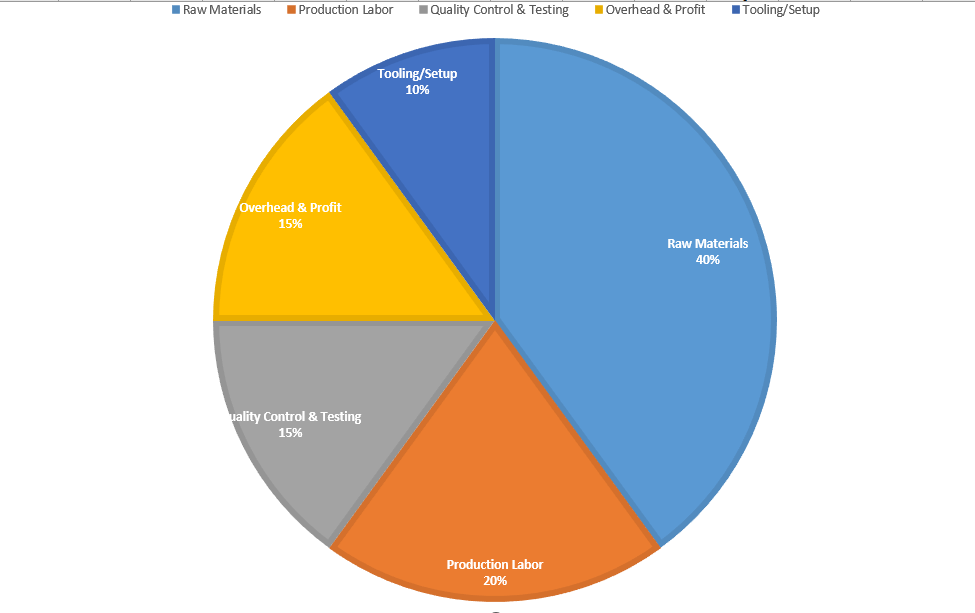
Understanding what you’re paying for is crucial. Costs in medical device manufacturing typically fall into two categories: non-recurring engineering (NRE) and variable per-unit costs. dinghmed’s project data reveals that NRE for a custom OEM device ranges from $15,000–$60,000 depending on regulatory class, while a standard ODM adaptation may require only $3,000–$8,000 in setup fees. The table below compares the typical MOQ and cost profiles for OEM versus ODM approaches.
| Cost & MOQ Factor | OEM (Custom Design) | ODM (Platform Adaptation) |
|---|---|---|
| Typical MOQ Range | 5,000 – 20,000 units | 500 – 2,000 units |
| Non-Recurring Engineering (NRE) | $15,000 – $60,000 | $3,000 – $8,000 |
| Tooling & Mold Investment | $8,000 – $30,000 | $0 – $2,000 |
| Regulatory Documentation Cost | $12,000 – $40,000 | $2,000 – $8,000 |
| Per-Unit Cost (at MOQ) | $3 – $12 | $5 – $18 |
| Lead Time (First Batch) | 16 – 24 weeks | 8 – 14 weeks |
As the table illustrates, a higher MOQ for OEM projects is balanced by significantly lower unit costs – but only if your demand forecasts justify the commitment. Conversely, ODM platforms from dinghmed allow smaller brands to enter the market with minimal upfront risk, albeit at a slightly higher per-unit price. In practice, we recommend running a breakeven analysis that factors in your projected sales volume over 12 months before choosing a path.
For early-stage companies, a pilot production run – typically 100–300 units – can validate the design and regulatory pathway before committing to full MOQ. dinghmed offers pilot runs for both OEM and ODM projects, with costs ranging from $5,000–$15,000 depending on complexity. This approach is recommended by industry organizations such as the Medical Device Manufacturers Association (MDMA) to de-risk scale-up.
Whether you are evaluating a low-Moq ODM product or a high-Moq custom OEM device, the key is to align production volume with realistic market demand. dinghmed’s engineering team can help you model total cost of ownership, including regulatory, tooling, and inventory carrying costs. Contact us to receive a free MOQ and cost assessment tailored to your specific product requirements.