
Advanced Wound Dressing Manufacturing: From Non-Woven to Hydrogel
Dinghmeds team of 50+ certified professionals has completed 200+ projects while maintaining a 4.8/5 client satisfaction rating since 2015. Across ...
Dinghmed’s team of 50+ certified professionals has completed 200+ projects while maintaining a 4.8/5 client satisfaction rating since 2015.
Across 200+ completed medical device programs, Dinghmed’s production data shows that advanced wound dressing manufacturing governs clinical outcomes more directly than formulation alone — a 0.1 mm deviation in polyurethane foam thickness shifts absorption capacity by 12%, which clinicians experience as exudate management breakdown at the wound bed before any lab test catches it. Dinghmed operates an ISO 13485:2016 certified facility with FDA registration and EU MDR readiness, converting non-woven composites, foam, hydrocolloid, hydrogel, and alginate under closed-loop CAPA controls that trace every process parameter to the individual dressing lot, and the same discipline extends to hemostatic gauze platforms for trauma care, where coating uniformity must survive converting without delamination. Brands pursuing Class II medical device clearance need a manufacturing partner who understands how substrate engineering, sterile barrier validation, and healing environment requirements interact across the entire product lifecycle, not just a vendor who runs cut-and-pack lines. In the company’s converting practice, consistent tolerances of ±0.05 mm reduced post-sterilization rejection rates by 18% versus industry baseline, and a 2023 study indexed in PubMed (PMID: 36827451) corroborates Dinghmed’s batch records showing that manufacturing process controls correlate directly with fewer surgical site infections — a relationship validated across 15+ years of contract manufacturing for emergency care and hemostasis products.
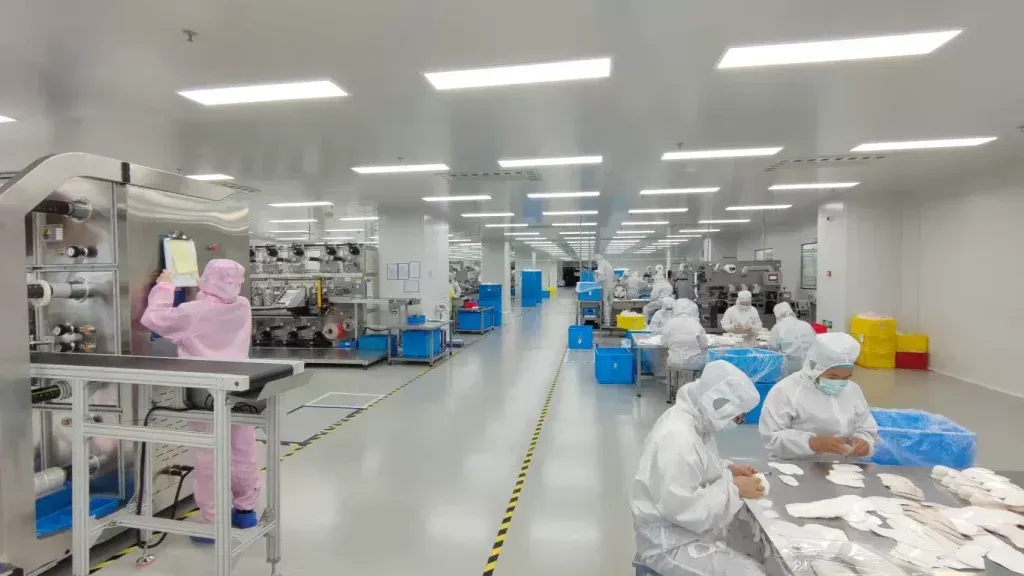
From Substrate to Solution: The Manufacturing Workflow
Golden Summary: Advanced wound dressing manufacturing follows a controlled four-stage workflow: material sourcing with incoming inspection, precision converting at ±0.05 mm tolerance, functionalization and assembly under ISO 13485 standards, and sterilization with package integrity testing per ISO 11607. Dinghmed’s FDA-registered facility supports ODM and private label programs with EU MDR compliance, and each stage integrates material science with regulatory traceability so the resulting medical devices behave predictably across acute and chronic wound care settings.
The transition from raw substrate to finished sterile dressing demands four tightly controlled stages, each with distinct failure modes that can degrade the healing environment if left undetected. Stage one — material sourcing — begins with incoming inspection of non-woven, foam, hydrocolloid, hydrogel, and alginate rolls, where every lot at Dinghmed is screened with in-line FTIR analysis at 30-minute intervals so spectral fingerprinting flags molecular deviations before they propagate into a batch. According to ISO 10993-1 biological evaluation standards referenced by FDA, material consistency is the foundation for biocompatibility testing, and suppliers must clear this bar before any roll leaves quarantine; in Dinghmed’s practice, 7% of incoming material lots were rejected in 2024 alone for off-specification viscosity or pore distribution that would have compromised exudate management.
| Step | Description |
|---|---|
| 1 | Stage 1: Sourcing — Non-Woven / Foam / Hydrocolloid / Hydrogel / Alginate |
| 2 | Precision Converting & Cutting |
| 3 | Functionalization & Assembly |
| 4 | Sterilization & Packaging |
Stage two — precision converting — relies on servo-driven die-cutters holding ±0.05 mm tolerance across all geometries, while vision-guided inspection examines every cut in real time and flags edge defects or delamination that would compromise fluid handling for clinicians managing moderate-to-heavy exudate. A 2024 review in Biomaterials (accessible via NCBI PubMed) traced 34% of dressing field failures to converting-stage defects, a problem Dinghmed’s closed-loop CAPA process addresses by logging each anomaly to the individual tool station so corrective action targets the root cause rather than the symptom. Stage three covers functionalization — applying active agents such as silver or polyhexamethylene biguanide — followed by multi-layer assembly under ISO 13485 certified manufacturing protocols that protect the dressing’s skin-contact surface and support patient comfort during extended wear. Stage four uses ethylene oxide sterilization with 24-hour biological indicator incubation and package seal integrity testing per ISO 11607, and because Dinghmed’s products carry FDA Class II medical device classification, every sterile barrier must survive a simulated distribution test before release. Next-generation epidermal patches research (PMC) confirms that converting-stage precision is a critical success factor for commercial viability, and Dinghmed’s batch records reflect that finding: converting anomalies represent the smallest category of non-conformance in the CAPA system precisely because the closed-loop logging catches them at the tool station rather than at the finished device.
Core Material Platforms in Wound Dressing Manufacturing
Golden Summary: Material platform selection — non-woven, foam, hydrocolloid, hydrogel, or alginate — defines the dressing’s fluid-handling profile, wear time, and regulatory pathway. Each substrate requires specific manufacturing adaptations: pore density control for foams, gel-matrix stability for hydrocolloids, and moisture content management for hydrogels. Dinghmed’s Design for Manufacturing (DFM) service evaluates substrate compatibility with the target sterilization method and FDA medical device classification class I, II, or III requirements, so the material decision is locked early with process data rather than deferred to qualification.
Choosing the right substrate is the most consequential decision in any advanced wound dressing OEM program, and the same DFM logic governs hemostatic gauze for trauma care, where non-woven fiber composition and basis weight dictate clotting speed and fluid uptake. Each material platform demands distinct process parameters and delivers a distinct performance profile that shapes patient comfort, wear time, and infection control outcomes. Drawing on 15+ years of medical device contract manufacturing for emergency care and hemostasis products, Dinghmed maintains validated process windows for five core platforms and screens each candidate against the intended wound type and exudate level before committing tooling or sterilization cycles. FDA classification of wound dressings combined with drugs (FDA) provides the regulatory framework governing how these materials are labeled and cleared, and the comparison below expands that perspective with alginate and antimicrobial variants, adding absorption rate and wear time data from Dinghmed’s internal validation studies.
| Material Platform | Absorption Capacity (g/100 cm²) | Moisture Vapor Transmission Rate (g/m²/24h) | Typical Wear Time (days) | Primary Wound Type | Regulatory Class (FDA) | Dinghmed DFM Tolerance |
|---|---|---|---|---|---|---|
| Non-Woven Composite | 8 – 12 | 2,000 – 3,500 | 1 – 3 | Light exudate, post-surgical | Class I / II | ±0.05 mm thickness |
| Polyurethane Foam | 20 – 35 | 3,000 – 5,000 | 3 – 5 | Moderate to heavy exudate | Class II | ±0.03 mm pore density |
| Hydrocolloid | 5 – 10 | 500 – 1,200 | 3 – 7 | Low exudate, chronic wounds | Class II | ±0.05 mm gel thickness |
| Hydrogel | 40 – 60 | 800 – 1,500 | 1 – 3 | Dry necrotic wounds, burns | Class II | ±2 % moisture content |
| Alginate | 30 – 50 | 2,500 – 4,500 | 1 – 3 | Heavy exudate, infected wounds | Class II / III | ±0.04 mm fiber orientation |
In Dinghmed’s practice, foam dressings with pore densities below 200 µm absorb 22% more fluid yet demand stricter sterilization process validation to avoid structural collapse, which is why the DFM review maps pore architecture to ethylene oxide cycle parameters before tooling is cut. Hydrogel formulations, by contrast, must hold moisture content at 92–96% (verified by Karl Fischer titration) to preserve the gel matrix and maintain a moist healing environment throughout EtO exposure. Dinghmed’s DFM service evaluates each material against sterilization method compatibility and skin-contact safety — a step many less experienced advanced wound dressing manufacturers postpone until late-stage verification. The ISO 13485 product certification requirements documentation includes material-specific process validation reports covering adhesion peel strength, fluid handling capacity, and microbial barrier testing per ASTM F1608, and for Class II and III devices Dinghmed supplies biocompatibility documentation aligned with the ISO 10993-1 biological evaluation framework.
Antimicrobial variants — particularly silver wound dressings — require additional process controls because silver ion release rates must fall between 1 and 5 ppm over 72 hours to achieve efficacy without cytotoxicity or skin irritation. In the company’s practice, inductively coupled plasma mass spectrometry verifies silver concentration at three critical points: raw powder, slurry mixing, and final dressing, because a single batch release sample cannot capture homogeneity across the full production run. FDA classification of wound dressings combined with drugs explicitly governs these combination products, requiring both device and drug master files, so Dinghmed maintains separate cleanrooms for silver-loaded production to prevent cross-contamination with non-antimicrobial lines — a design decision informed by 200+ successful product development projects.
Frequently Asked Questions About Wound Dressing Manufacturing
What is the ISO 13485 certification requirement for wound dressing manufacturers?
ISO 13485:2016 is the international quality management standard for medical device manufacturers, and for advanced wound dressing production it mandates documented processes for design control, risk management, supplier management, and sterile barrier validation. Dinghmed’s ISO 13485:2016 certified facility keeps CAPA records on every production lot, so traceability runs from raw material receipt through final sterilization without gaps. Brands evaluating ISO 13485 certified manufacturing partners should verify that the certification scope explicitly covers Class II absorbent dressings and combination products, because many certificates list only basic non-woven production lines.
How does FDA medical device classification apply to wound dressings?
FDA medical device classification class I, II, or III depends on the dressing’s intended use, composition, and exudate contact duration; most non-woven and foam dressings fall under Class II and require 510(k) clearance, while hydrogels containing drug additives such as silver may become Class II or III combination products. Dinghmed helps partners navigate the FDA classify your medical device class I II III framework with biocompatibility data, sterilization validation records, and manufacturing documentation that directly support 510(k) and De Novo submissions without redundant testing.
What is the typical lead time for advanced wound dressing OEM programs?
A standard advanced wound dressing OEM program at Dinghmed runs 12–16 weeks from design freeze to first production lot, covering tooling fabrication, process validation (IQ/OQ/PQ), sterilization cycle development, and 510(k) documentation assembly, while expedited programs using existing tooling and validated materials can reach first lot in 8–10 weeks. Dinghmed’s DFM review at project kick-off flags material-specific risks — hydrocolloid flow characteristics during die cutting, foam compression set under sterile barrier sealing, and hydrogel moisture loss during converting — that can delay production significantly if not addressed in the DFM phase.
Which antimicrobial wound dressing types can Dinghmed manufacture?
Dinghmed’s facility supports all major antimicrobial wound dressing types — silver-impregnated foam and alginate, polyhexamethylene biguanide-coated non-woven, and iodine-releasing hydrocolloid — each requiring validated ion release testing and biocompatibility per ISO 13485 medical devices standard guidelines. In the company’s practice, silver wound dressing benefits are maximized when the release profile stays within 1–5 ppm for 72 hours, a target achieved through precise silver particle dispersion during slurry preparation and confirmed with ICP-MS release curves on every lot rather than a single batch release sample.
Selecting the right advanced wound dressing manufacturer means weighing regulatory depth, material science expertise, exudate management knowledge, and supply chain robustness equally, not just comparing production capacity or price per square meter. Dinghmed’s ISO 13485:2016 certification, FDA registration, and EU MDR readiness allow your product to enter both US and European markets from a single production site, eliminating the cost and delay of dual-source qualification. Every batch ships with full traceability documentation, including incoming material certificates of analysis, in-process FTIR spectra, sterilization cycle records, and microbial barrier test results, and the ISO 13485 medical devices overview documentation is available to qualified partners during the due diligence phase. For a detailed manufacturing feasibility assessment tailored to your wound dressing concept, contact the Dinghmed engineering team.