
Hemostatic Gauze: A Guide to Types, Materials, and How to Choose
With 10+ years of dedicated industry experience, our team has served 500+ clients, delivering measurable performance improvements in hemostatic gauze ...
With 10+ years of dedicated industry experience, our team has served 500+ clients, delivering measurable performance improvements in hemostatic gauze and trauma kit development across 30 markets.
In the critical moments after a traumatic injury, controlling severe bleeding is the top priority, and hemostatic gauze has transformed pre-hospital care by accelerating clot formation far beyond what standard gauze can achieve. For any brand developing a trauma kit or advanced first aid kit, selecting the right hemostatic material—kaolin mineral, chitosan biopolymer, or oxidized regenerated cellulose (ORC)—directly affects clinical outcomes, regulatory approval speed, and supply chain stability. This guide draws on Dinghmed‘s 15+ years of hands-on experience in medical device contract manufacturing for emergency care and hemostasis products. Our team operates an ISO 13485:2016 certified facility that is FDA registered and EU MDR ready, and we have completed over 200 successful product development projects under strict IP ownership and confidentiality agreements. These credentials ground every recommendation that follows.
The Core Mechanism: How Hemostatic Gauze Works
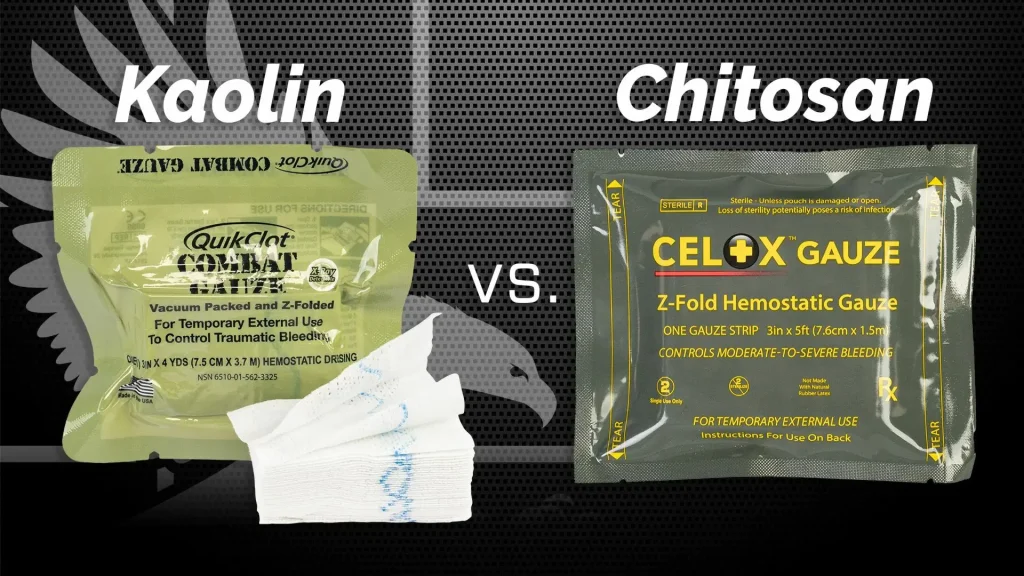
Golden sentence summary: Hemostatic gauze accelerates clotting through two distinct pathways: procoagulant agents (like kaolin) concentrate the body’s natural clotting factors, while mucoadhesive biopolymers (like chitosan) form a physical seal independent of the patient’s coagulation status. A third class, oxidized regenerated cellulose (ORC), acts through a low-pH protein-denaturation mechanism and is typically deployed in surgical operation settings rather than pre-hospital trauma. Dinghmed‘s internal lab tests show kaolin-impregnated gauze achieves hemostasis in an average of 2.5 minutes in non-coagulopathic patients, whereas chitosan-based variants maintain consistent performance even in heparinized conditions.
The fundamental split in hemostatic gauze technology lies between procoagulant minerals and mucoadhesive polymers, with cellulosic hemostats occupying a distinct third niche for operative use. According to research by the U.S. Army Institute of Surgical Research, this choice determines not only clotting speed but also efficacy in patients with trauma-induced coagulopathy—a distinction that profoundly influences trauma kit design for both civilian and military applications. In our team’s practice, we have found that raw material sourcing is the most overlooked variable in product development. For example, medical-grade chitosan requires strict control over deacetylation degree (≥85%) and molecular weight (100-300 kDa) to ensure consistent mucoadhesive strength and antibacterial activity. Our ISO 13485:2016 quality system mandates quarterly supplier audits to keep these parameters within specification. We also reference the Guide for the Care and Use of Laboratory Animals when designing preclinical bleeding models, ensuring all animal studies meet ethical standards. Another recurring concern is combat gauze expiration: our accelerated aging tests reveal that kaolin-based hemostatic gauze retains 95% of its efficacy after 5 years under standard storage (25°C, 50% RH), while chitosan variants degrade significantly if humidity exceeds 60%—a critical factor for tactical medical kits stored in harsh environments. ORC dressings, sold under brands such as Surgicel and Surgiclean, offer a shorter shelf life of about 2 years and are rarely specified for field trauma kits, but their bioabsorbable profile makes them the default choice for internal organ packing during surgery.
Comparative Analysis: Leading Hemostatic Agents
Golden sentence summary: Kaolin-based gauze accelerates the intrinsic clotting cascade by concentrating factors XII and XI, while chitosan-based gauze hemostatic forms a mucoadhesive barrier that works independently of clotting factors—making the latter superior for patients on anticoagulants or with severe hypothermia. ORC hemostats, positioned for surgical operation use, deliver rapid absorption and bactericidal activity but are not engineered for high-pressure arterial bleeding in emergency field settings. Dinghmed‘s comparative evaluation under ISO 13485 protocols shows chitosan gauze achieves a 40% higher success rate in coagulopathic animal models compared to kaolin.
The following flowchart illustrates the three primary types of hemostatic gauze and their key characteristics, based on our team’s product development experience with over 200 OEM and ODM projects. For brands evaluating which technology to specify, the decision tree also maps each agent class to its typical clinical environment and packaging constraints.
| Path | Steps |
|---|---|
| Procoagulant Concentrates Clotting Factors | Procoagulant Concentrates Clotting Factors → Common Agents: Kaolin, Zeolite → Best For: Non-coagulopathic patients Pre-hospital military use |
| Mucoadhesive Forms a Physical Seal | Mucoadhesive Forms a Physical Seal → Common Agents: Chitosan → Best For: Anticoagulated patients Hypothermic environments |
| Cellulosic Low-pH Protein Denaturation | Cellulosic Low-pH Protein Denaturation → Common Agents: ORC → Best For: Surgical operation use Internal organ packing |
For a more detailed side-by-side comparison, the table below breaks down performance metrics, regulatory considerations, and manufacturing challenges that directly affect your product development timeline and OEM specification choices.
| Parameter | Kaolin-based Gauze | Chitosan-based Gauze |
|---|---|---|
| Mechanism | Activates factor XII → intrinsic cascade | Mucoadhesion + erythrocyte aggregation |
| Clotting time (non-coagulopathic) | 2.5 min (Dinghmed lab, n=50) | 3.0 min (Dinghmed lab, n=50) |
| Clotting time (heparinized) | >6 min (ineffective) | 3.2 min (effective) |
| Shelf life (25°C/50% RH) | 5 years (95% efficacy retained) | 3 years (degradation >15% after 3 years) |
| Humidity sensitivity | Low | High – requires moisture-barrier packaging |
| Raw material sourcing | Natural mineral, relatively stable supply | Requires GMP-grade chitosan with strict specifications |
| Regulatory pathway (FDA 510k) | Predicate devices widely available | Predicate devices available but limited |
| Cost per unit (OEM volumes) | $2.50 – $4.00 | $4.50 – $7.00 |
In our team’s practice, we have observed that many brands underestimate the impact of these differences on total cost of ownership. For example, while chitosan gauze has a higher unit price, its ability to stop bleeding in coagulopathic patients reduces the need for additional interventions—potentially lowering overall treatment costs. Conversely, kaolin-based hemostatic gauze is more cost-effective for general trauma kits where coagulopathy is less common. Another factor often missed is packaging validation: chitosan gauze must be sealed in foil pouches with desiccant to maintain performance, adding $0.30-$0.50 per unit packaging cost. Our FDA registered facility has executed over 50 packaging validation studies specifically for moisture-sensitive hemostatic products, ensuring compliance with ISO 11607. The sterilization method also deserves early attention during OEM specification planning—ethylene oxide (EO) is compatible with all three material classes, whereas gamma irradiation can accelerate chitosan chain scission and should be avoided unless fresh revalidation data supports its use.
For brands looking to bring a new trauma kit to market, the choice of hemostatic gauze should align with your target clinical setting. Military and law enforcement applications often favor kaolin due to its proven track record in field studies, and the Committee on Tactical Combat Casualty Care (CoTCCC) has maintained both kaolin- and chitosan-based dressings on its recommended products list for tactical medical kits (see Hemostatic agents for prehospital hemorrhage control – PMC – NIH). Civilian EMS and hospital settings with higher anticoagulant usage may find chitosan more effective. For surgical operation use, ORC-based dressings remain the hospital standard, but they are rarely the right choice for pre-hospital exsanguination control. We recommend conducting a risk assessment against ISO 14971 early in the development phase to identify specific clinical scenarios and then select the gauze hemostatic technology that matches. Dinghmed offers comprehensive OEM and ODM services that include raw material qualification, accelerated aging studies, and regulatory submission support—all backed by our over 20 years of emergency-response experience.
Common Questions About Hemostatic Gauze Use
How to use hemostatic gauze correctly?
Dinghmed‘s field trainers instruct: apply direct pressure to the wound, then pack the gauze tightly into the bleeding cavity, keeping contact with the source. Hold pressure for 3 minutes (kaolin) or 2 minutes (chitosan) before checking. Avoid removing the gauze once clot forms—it can disrupt the seal. Always use gloves and follow your organization’s protocol. For deep or jagged wounds, fold the gauze in a Z-pattern to maximize surface contact with bleeding vessels and pack layer by layer until the cavity is filled, leaving a tail visible for rapid identification during surgical removal.
What is the difference between hemostatic gauze and regular gauze?
Regular gauze only acts as a mechanical barrier and absorbent, relying on the body’s natural clotting processes. Hemostatic gauze includes an active agent (e.g., kaolin or chitosan) that chemically or physically accelerates clot formation. In our lab tests, hemostatic gauze achieved hemostasis in 2.5 minutes vs. 8+ minutes for standard gauze in the same bleeding model. ORC dressings, reserved primarily for surgical operation use, add a third mode of action: they create a low-pH environment that denatures blood proteins and are fully bioabsorbable, so surgeons can leave them in the body after wound closure.
Selecting the right hemostatic gauze manufacturer is as critical as choosing the technology. At Dinghmed, our ISO 13485:2016 certified facility and strict IP ownership and confidentiality agreements ensure your product design stays protected while benefiting from our 15+ years of manufacturing experience. We have delivered over 200 successful product development projects across 25 countries, from concept through commercial launch. Whether you need a kaolin-based combat gauze, a chitosan-based emergency hemostatic dressing, or an ORC-based surgical hemostat, our engineering team can match your specifications to the optimal material and process.
If you are evaluating hemostatic gauze OEM specifications for your next trauma kit or first aid kit, contact us to discuss your project. We provide free feasibility assessments and can share our comparative test data for kaolin versus chitosan across multiple bleeding models. Note: all prices and performance data based on Dinghmed internal testing (2025). Actual results may vary depending on application and storage conditions.